
The First-Meeting Questions
The set of questions a partner asks in a first meeting, codified as a self-administered instrument — what each one tests beneath the surface, and how to read a strong answer from a weak one.
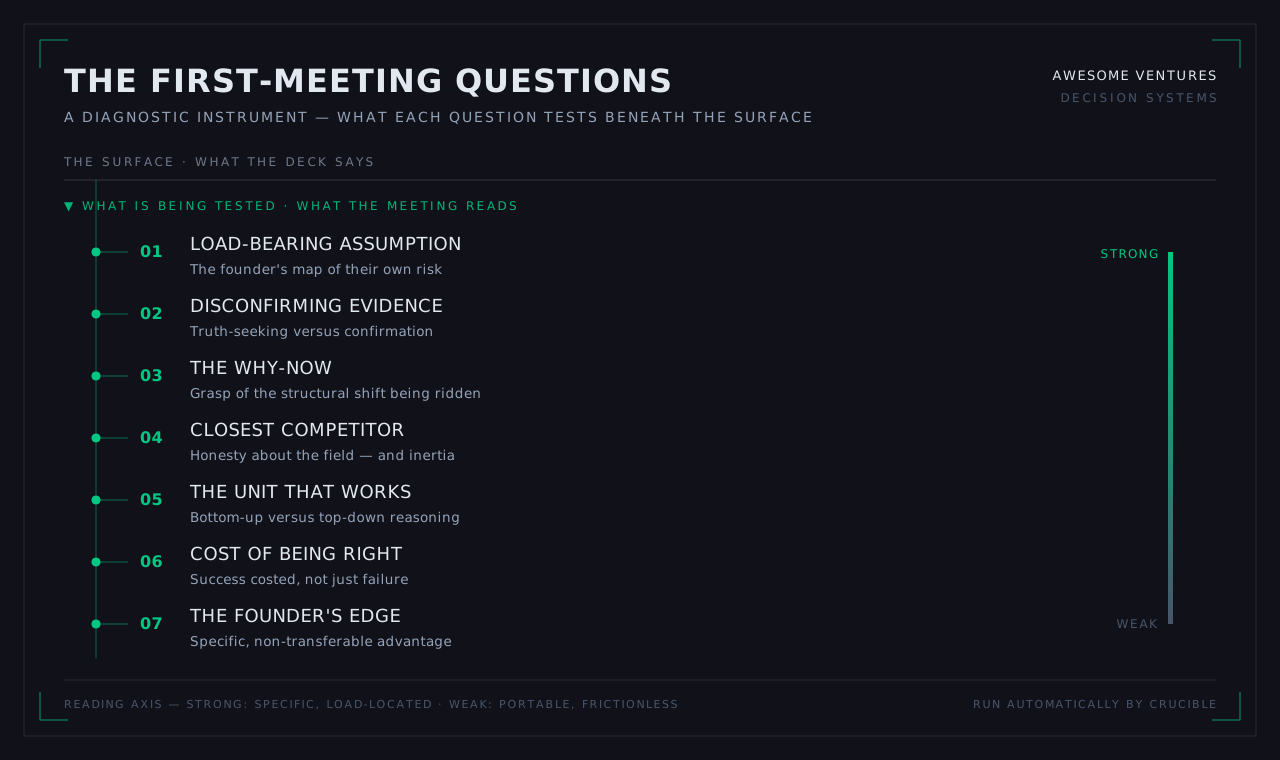
What a first meeting actually tests
A first meeting is not a presentation review. By the time a founder sits down, I have already skimmed the deck; the slides are not the thing under examination. What I am testing is narrower and harder to fake: whether the person across the table knows which parts of their own story are load-bearing, and whether they can tell the difference between a claim they have stress-tested and one they have only repeated.
Across the meetings I sat in over the years, the questions that did the most work were rarely about the market or the product. They were about the founder’s relationship to their own argument. A good answer was not the confident one. It was the one that located the weakest joint in the structure before I had to — and stayed standing anyway.
What follows is the canonical set I came back to. I never asked them in order, and I rarely asked all of them. But each one tests something specific, and a founder can run them on their own story before anyone runs them in a room. The point of writing them down is to make the interrogation portable: an instrument you can administer to yourself, not a script to anticipate.
The questions
1. The Load-Bearing Assumption
The question: Which single assumption, if it turned out to be wrong, would take the whole company down with it?
What it tests: Not the assumption itself — the founder’s map of their own risk. Every venture rests on a small number of beliefs that the rest of the structure hangs from. A founder who has done the work can name theirs without flinching. A founder who has not will reach for something peripheral, because the real load-bearing assumption is the one they have decided not to look at.
Strong vs weak: A strong answer names the assumption precisely, explains why it is the fragile one rather than a safer-sounding substitute, and describes what evidence would move it. A weak answer either claims there is no such assumption — which means they have not found it — or names a risk that is real but survivable, which means they are managing the question rather than answering it.
2. The Disconfirming Evidence
The question: What have you learned in the last six months that argued against your own thesis — and what did you do about it?
What it tests: Whether the founder is running a search for truth or a campaign for confirmation. Anyone building something has accumulated evidence; the question is whether they let the inconvenient evidence land. In my experience the founders who lasted were the ones who could recount, specifically, the moment the data pushed back and how they updated.
Strong vs weak: A strong answer is concrete and slightly uncomfortable — a real instance where reality disagreed, followed by a change in plan, pricing, or sequence. A weak answer is frictionless: everything has gone to plan, every signal confirms the thesis. Frictionless is not strength. It means the founder is not looking, or is not telling you what they saw.
3. The Why-Now
The question: Why is this possible now, when it was not possible three years ago — and why will the window not stay open for everyone?
What it tests: Whether the founder understands the structural shift they are riding, or has simply noticed that the idea sounds timely. Most durable companies sit on top of a specific change — a cost that fell, a regulation that moved, a capability that crossed a threshold. The founder who can name the inflection understands their own leverage. The one who cannot is hoping timing will be retrofitted by a believer.
Strong vs weak: A strong answer points to a precise change with a direction and a clock, and explains why incumbents cannot simply copy the response once it works. A weak answer gestures at a trend — adoption is growing, AI is everywhere — without locating the specific door that opened. Trends are not why-nows. A why-now has an edge that others have not yet crossed.
4. The Closest Competitor
The question: Who is the most dangerous alternative to you — including the alternative of customers doing nothing — and why do you win against it?
What it tests: Honesty about the competitive field, and whether the founder has confused absence of a named rival with absence of competition. The most revealing tell is how a founder treats the do-nothing option. I watched far more deals lose to inertia than to a competitor, and the founders who underwrote that risk were the ones who had thought hardest about why anyone would change behaviour at all.
Strong vs weak: A strong answer names a real and capable alternative, treats it with respect, and draws the line of advantage at something structural rather than cosmetic. It takes the do-nothing customer seriously. A weak answer claims no real competition, or dismisses rivals as inferior without explaining why the inferiority is durable. “We have no competitors” is not a moat. It is usually a gap in the search.
5. The Unit That Has to Work
The question: What is the single unit of your model — one customer, one transaction, one cohort — that has to work, and what does it actually look like today?
What it tests: Whether the founder reasons from the ground up or from the headline down. The aggregate numbers in a deck are an output. The question is whether the founder can drop to the level of the unit and describe it with the texture of someone who has watched it happen, rather than someone who has modelled it in a spreadsheet.
Strong vs weak: A strong answer goes immediately to the concrete unit and describes its real behaviour — what it costs to acquire, how it retains, where it leaks — with the specificity of lived observation. A weak answer stays at the level of the total addressable market and the projection, because the unit underneath has not yet been examined closely enough to survive a question.
6. The Cost of Being Right
The question: If everything goes right, what does it take — in capital, in time, in people — and what breaks first as you scale?
What it tests: Whether the founder has costed their own success, not just their failure. Plenty of founders can describe the upside. Fewer have asked what the upside demands and where the structure strains when it arrives. The question separates ambition that has been pressure-tested from ambition that has only been imagined.
Strong vs weak: A strong answer treats success as an operational problem with its own failure modes — the hire that becomes the bottleneck, the capital intensity that arrives with scale, the support load that grows faster than revenue. A weak answer treats success as the end of the difficulty rather than the start of a different one. The founders I trusted most were uneasy about their own best case, not just their worst.
7. The Founder’s Edge
The question: Why you — what do you understand about this problem that a smart, well-funded stranger would take years to learn?
What it tests: Whether the founder has a real, specific edge, or a generic claim to grit. The strongest answers were rarely about credentials. They were about a particular, hard-won understanding of the domain — the kind that comes from having lived inside the problem long enough to know where its non-obvious traps are.
Strong vs weak: A strong answer is specific and almost narrow — a precise piece of domain knowledge, a relationship to the customer that took years to earn, a scar that taught a lesson a newcomer would have to pay full price for. A weak answer is portable to anyone: passion, work ethic, a strong team. Those are table stakes, not an edge. The edge is the thing that would not transfer if someone else tried to copy the plan.
How to use it
Run the seven on your own story before anyone else does. Take each question literally, answer it out loud, and watch for the answers that come too easily — the frictionless ones are usually the unexamined ones. The instrument is not a rehearsal aid for the meeting; it is a way to find the weak joint while you can still reinforce it.
The pattern I kept seeing was that the founders who fared best in a first meeting were not the ones who had memorised better answers. They were the ones who had already asked themselves the harder version of every question, found the soft spots, and either fixed them or learned to name them honestly. The interrogation was not adversarial. It was the same examination they had already run on themselves.
I run this by hand in a first meeting. Crucible runs it automatically, on your deck, before that meeting → crucible.askodin.app.